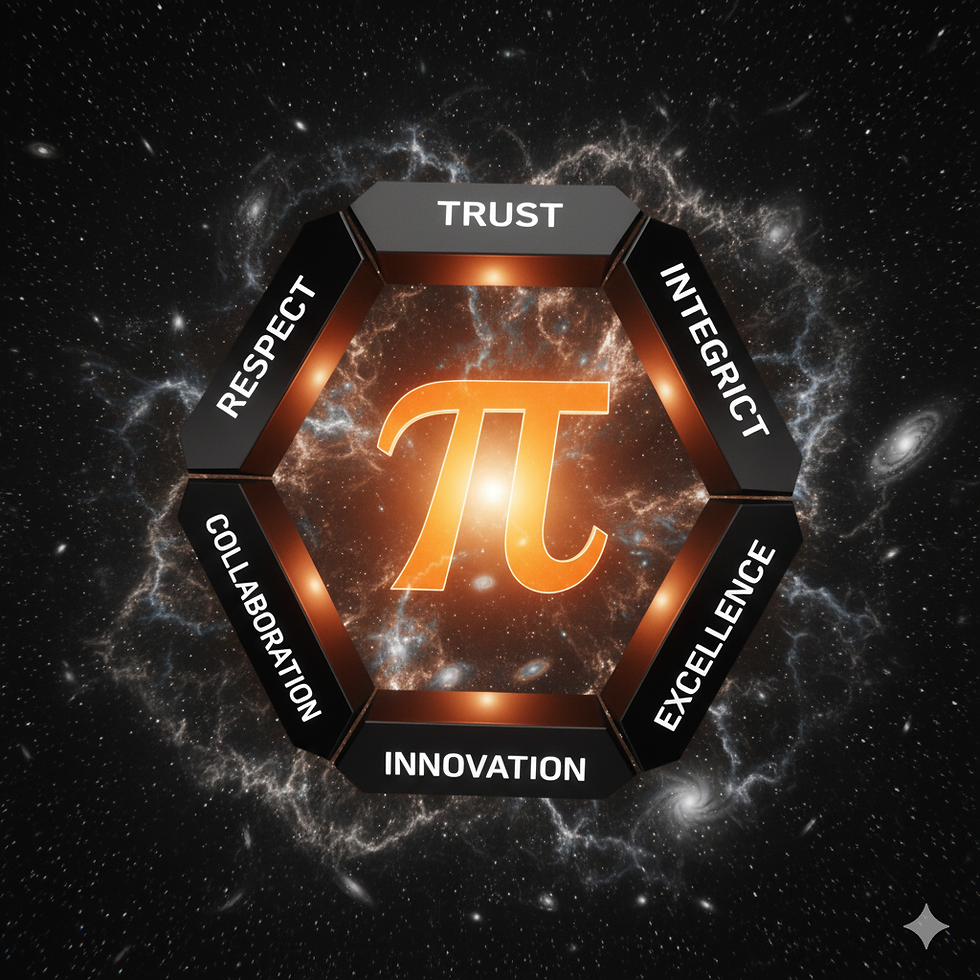
The π-Control Platform unites all six in a single cryptographic fabric, transforming digital interaction from trust-by-assumption to trust-by-proof.
The Holy Grail of Cybersecurity
Every secure digital interaction — whether human-to-machine or API-to-API — rests on six universal foundations:
Identity
knowing who or what is communicating.
Authentication
proving that identity is genuine.
Authorization
ensuring the right permissions exist.
Confidentiality
keeping exchanges private.
Provability
being able to verify every action.
Privacy
ensuring data never leaves without consent.
Built for the Quantum Future

π-Control is quantum-safe by design.
It replaces certificate-based and shared-key models with post-quantum cryptographic methods that ensure confidentiality, authenticity, and forward secrecy.
No central authorities. No trust bottlenecks.
Just verifiable, point-to-point assurance between entities — secure today and tomorrow.

The Problem: Fragmented Trust
Traditional cybersecurity is a patchwork:
-
Identities managed by one system,
-
Access by another,
-
Privacy treated as compliance paperwork.
Each uses different keys, tokens, and certificates that can be stolen, forged, or revoked.
The result — fragmented assurance and expanding attack surfaces.
The world doesn’t need another layer of security. It needs a new foundation for trust.


Identity Innovation: Re-imagining Who You Are Online
The biggest flaw in today’s security isn’t encryption — it’s identity.
Most systems still define identity as a credential — something you remember or store.
π-Control replaces that with I-AM® Crypto-ID [India Patent No. 419610] — a dynamic, self-evolving identity that changes with you.
Instead of static usernames, passwords, or certificates, each entity — human, app, or device — carries an identity derived from its own attributes, updated continuously and verifiable cryptographically.
Why It Matters:
-
Immutable History: Past attributes can’t be changed; every update adds a new verifiable layer.
-
Self-Evolving: Each new state builds on all previous states, making identity future-aware yet history-bound.
-
Attribute-Based Authentication: Verification happens by re-proving real attributes (like Aadhaar, Tax ID, device ID), not secrets.
-
Uniqueness: No two entities share the same attribute chain — every identity is mathematically distinct.
-
Provable Verifiability: Any claim can be validated against signed digital or physical documents, ensuring non-repudiation.
-
Privacy by Design: Only relevant attributes are revealed during authentication — nothing more.
Introducing the π-Control Platform
π-Control is a cryptographic operating system for trust.
It ensures that every digital interaction — no matter who or what is involved — follows the same provable sequence:

1. Mutual Identity Verification
2. Trustless Authentication
3. Built-in Authorization via OAuth Tokens
4. Confidential Communication Protected by PQC
5. Provable Interaction Records
6. Privacy Enforced Through Consent
Security isn’t added at the end; it’s woven into every conversation.

The Architecture of Trust
The π-Control Platform serves as the root of trust for every Fortytwo Labs offering:
MFA42
Human identity assurance
Passwordless42
proving that identity is genuine.Frictionless verification
SecureAPI42
Trusted digital transactions
ACCESS42
Quantum-safe direct access
COMM42
Confidential communication
AUTH42
Tamper-proof data movement
Each product draws from the same π-Control foundation — ensuring consistent assurance from identity to data